
LiFePO4 vs. Tubular Lead-Acid Batteries: 10-Year TCO Cost Analysis
A 10-year Total Cost of Ownership (TCO) financial model comparing Lithium Iron Phosphate (LiFePO4) with tubular lead-acid batteries for Bangladesh commercial users.
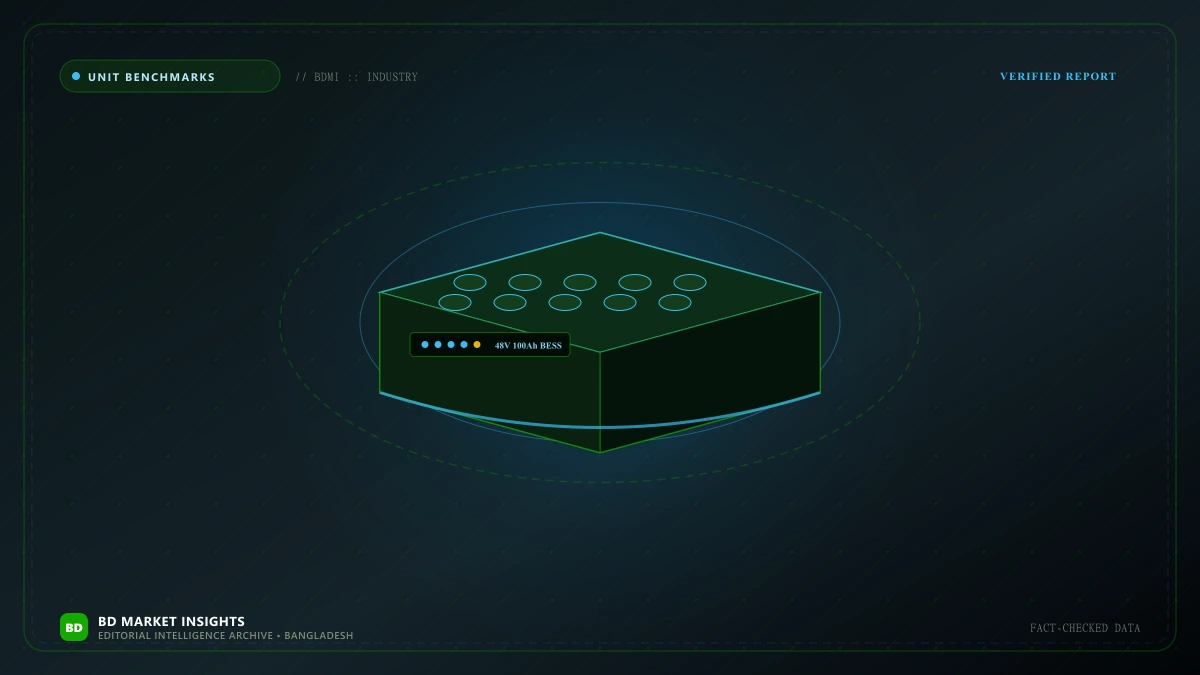
Executive Overview & Strategic Context
A 10-year Total Cost of Ownership (TCO) financial model comparing Lithium Iron Phosphate (LiFePO4) with tubular lead-acid batteries for Bangladesh commercial users.
Corporate plant engineers, telecom facility directors, and commercial solar investors in Bangladesh face a critical financial dilemma: should they continue purchasing locally smelted tubular lead-acid batteries or transition to modern Lithium Iron Phosphate (LiFePO4) packs? While lead-acid boasts lower upfront sticker prices, rigorous Total Cost of Ownership (TCO) modeling reveals that LiFePO4 delivers decisive lifecycle cost savings.
Market Data & Structural Benchmarks
| Evaluation Parameter | Tubular Heavy-Duty Lead-Acid | Lithium Iron Phosphate (LiFePO4) | Financial / Operational Advantage |
|---|---|---|---|
| Initial Upfront Capex (per kWh) | BDT 12,000 – 15,000 | BDT 28,000 – 35,000 | Lead-Acid has 55% lower initial cost |
| Cycle Life at 80% Depth of Discharge | 700 – 1,000 Cycles | 3,500 – 5,000 Cycles | LiFePO4 lasts 4x to 5x longer |
| Replacements Required in 10 Years | 3 to 4 Complete Battery Banks | 0 (Single Pack Horizon) | LiFePO4 eliminates repeated reinvestment |
| Round-Trip Energy Efficiency | 75% – 80% (Energy Loss) | 95% – 98% (Low Loss) | LiFePO4 saves 18% in monthly charging power |
| Weight & Floor Space Footprint | Extremely heavy (Requires reinforced floor) | 70% lighter, compact rack-mountable | LiFePO4 frees valuable factory floor space |
| 10-Year Lifecycle Cost per kWh | BDT 42.50 / delivered kWh | BDT 24.80 / delivered kWh | LiFePO4 delivers 41% net lifecycle savings |
Technology & Operational Comparative Analysis
When to Invest in Lithium Iron Phosphate (LiFePO4)
- High-Cycle Daily Applications: Unbeatable financial ROI for 3-wheeler e-rickshaws, commercial solar self-consumption, and telecom towers cycling daily.
- Space-Constrained Rooftops & Offices: High energy density enables installation in tight server racks without hazardous acid fumes.
When Tubular Lead-Acid Remains Viable
- Infrequent Emergency Backup: Budget-friendly choice for residential standby UPS systems cycling only 2-3 times per month.
- Mature Scrap Salvage Value: Existing lead-acid recycling networks provide an immediate 25-30% cash rebate on spent battery cores upon replacement.
Forward Market Outlook
As Bangladesh continues its industrial modernization, corporate leaders and policymakers must navigate international standards, digital transformation, and infrastructural investments. BD Market Insights will continue to track structural indicators and publish verified updates.
Sources, Data & References
In accordance with BD Market Insights Editorial Standards, all factual claims, market sizes, and corporate data cited in this publication are cross-referenced with official filings, regulatory bodies, and industry documentation.
- SREDA Technical Benchmark Reports — sreda.gov.bd (Accessed: September 28, 2026)
- BEMMA Battery Economic Whitepaper — bemma.org.bd (Accessed: September 28, 2026)
Key Corporate Entities & Manufacturers Mentioned
Verified corporate entities covered in this briefing
Bashundhara Group
One of the largest industrial conglomerates in Bangladesh, operating market-leading production facilities in cement, paper and tissue, LP gas distribution, oil refining, and industrial packaging.
BSRM Steels Limited
DSE: BSRMSTEELBangladesh's largest steel rebar and structural steel manufacturer, providing high-tensile reinforcement bars for major national infrastructure megaprojects.
BD Market Insights Editorial Team
The BD Market Insights editorial desk compiles verified industry briefings, market data analysis, and company intelligence across Bangladesh economic sectors. All articles published by the desk adhere to independent journalistic scrutiny and rigorous verification against primary sources.
Frequently Asked Questions
Operational, regulatory, and market intelligence answers curated for this report.
What are the primary regulatory authorities governing industry projects in Bangladesh?
Renewable energy and power initiatives in Bangladesh are overseen by the Power Division under the Ministry of Power, Energy and Mineral Resources (MPEMR), the Bangladesh Power Development Board (BPDB), the Sustainable and Renewable Energy Development Authority (SREDA), and the Bangladesh Energy Regulatory Commission (BERC).
How do domestic equipment standards compare to imported equivalents?
Industrial equipment deployed in Bangladesh must comply with BSTI standards and international benchmarks such as IEC, IEEE, and UL. Top domestic assemblers now source Tier-1 components and utilize certified testing facilities at BUET for compliance verification.
What incentives are available for commercial and industrial clean energy adoption?
Commercial entities benefit from net metering guidelines (enabling export of surplus rooftop solar energy), concessionary financing facilities from IDCOL, and reduced import duties on specialized renewable capital machinery under BIDA industrial registration.
Related Market Intelligence
Relevant briefings, sectoral analysis and market data
Manufacturing Productivity: Bangladesh vs. Vietnam Benchmark
A benchmark comparing minimum wages, labor productivity, power tariffs, container port dwell times, and supply chain lead times between Bangladesh and Vietnam.
Captive Gas Generator vs. Commercial Solar Net Metering: ROI Model
Financial comparison between natural gas captive generators and rooftop solar PV net metering for 1MW industrial manufacturing plants in Bangladesh.
Cotton vs. Man-Made Fiber (MMF): Bangladesh RMG Competitiveness
Analyzing the global fashion shift from pure cotton to synthetic polyester and viscose fibers, and how Bangladesh garment exporters are adapting.